
Anyone using a SERP tracker ultimately wants to know one thing: Where does my keyword rank right now?
To answer that question, the relevant search results need to be retrieved regularly. Some delay within the intended update cycle is not a problem for me. What matters is that an up-to-date and verifiable ranking result is available afterwards.
I have been using SerpWatch for around six years. During that time, the tool worked reliably for me over long periods. More recently, however, I have repeatedly observed situations in which keywords were not updated for extended periods.
This article documents a recent development in my SerpWatch account.
16 Keywords – all updated, all outside the Top 100
One of my SerpWatch projects contains 16 keywords.
On August 20, 2026, after another update, SerpWatch showed that all keywords had been updated. The next regular update was not scheduled until the following day.
At first, this suggested that the previously missing updates had finally been completed.
However, looking at the actual ranking results showed a different picture:
All 16 keywords were shown at position 100 or outside the tracked Top 100.
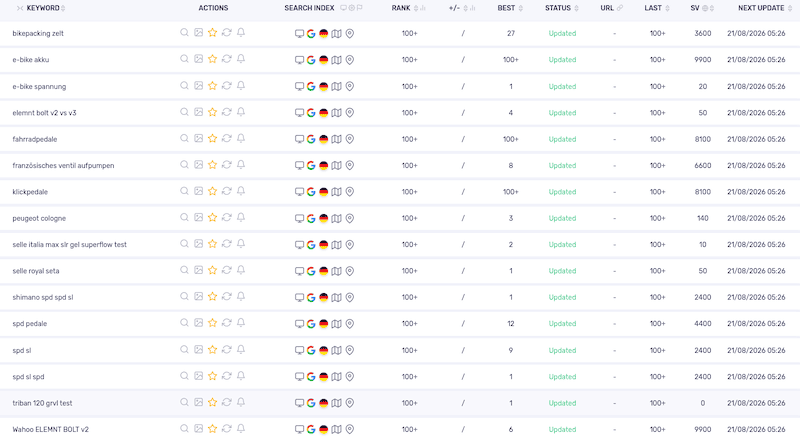
That is striking. It is not just one or two keywords showing unusually poor rankings. All 16 keywords are outside the Top 100 after the supposedly completed update.
This raises the crucial question of whether these are actually current ranking data.
Example: “E-Bike Spannung”
One particularly clear example is the keyword “E-Bike Spannung.”
The keyword is one of the rankings for the website I have been monitoring regularly for months. In approximately 95% of the cases I have observed, it ranks at position 1, and otherwise at position 2. During this period, I have never observed it ranking outside the Top 10.
SerpWatch itself has also previously recorded this keyword at position 1. Its historical best position is likewise shown as position 1.

On August 20, 2026, I also checked the keyword directly on Google. “E-Bike Spannung” was ranking at position 1.
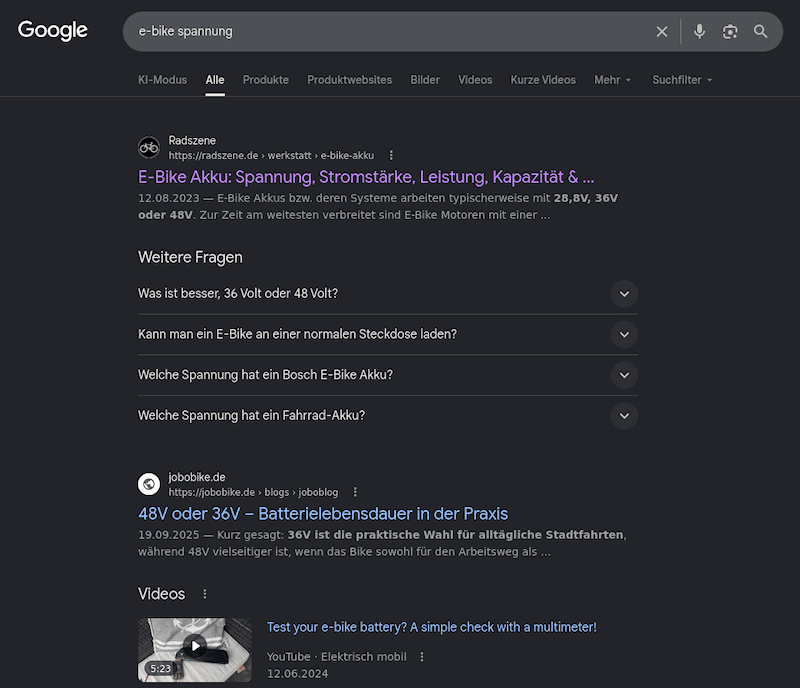
The Google screenshot documents my check at that time. It does not prove that the keyword ranks at position 1 at every possible point in time. However, I have been monitoring this keyword for months and know its typical ranking behavior.
The important point is therefore the combination of the available observations:
- SerpWatch currently shows the keyword at position 100 or outside the Top 100.
- SerpWatch itself records a historical best position of 1 for the same keyword.
- In my timely check on Google, the keyword ranks at position 1.
- At the same time, all 16 keywords in my SerpWatch project are shown outside the Top 100 after the supposedly completed update.
This is not a normal small ranking discrepancy.
Of course, Google results can vary depending on location, device, and other parameters. A difference between position 1 and outside the Top 100, however, is on a completely different scale.
The issue is not the individual position
An individual keyword can of course rank lower at any given time.
That is why the result for “E-Bike Spannung” alone is not what I find most significant.
What stands out is the pattern:
SerpWatch reports that the update is essentially complete – and all 16 keywords are then shown outside the Top 100.
This is therefore not just about one keyword whose ranking may have changed.
It affects the entire keyword list of this project.
The interface is therefore signaling a different state from what the displayed ranking data would suggest.
What exactly was updated here?
That is the interesting part for me.
Just a few days earlier, the problem was that the keywords in my project were not being updated reliably over extended periods.
On August 20, 2026, SerpWatch suddenly showed:
100% updated
The engine therefore appears to be back in its normal state. No prolonged update process is being displayed anymore.
The ranking results themselves, however, are striking:
All 16 keywords outside the Top 100.
For a keyword whose ranking I have known for months, and which SerpWatch itself has previously recorded at position 1, a timely Google check also shows position 1.
So from my perspective, the original problem has not simply gone away.
The interface now says that the keywords have been updated. Yet the resulting rankings are, at least in this specific case, not plausible.
A documented snapshot
I do not want to use this to make a general claim that SerpWatch systematically provides incorrect rankings.
I am documenting a specific state of my own account on August 20, 2026.
This includes the SerpWatch status display, the rankings shown there, the historical best position of the specific keyword, and my timely check on Google.
The screenshots do not reveal the technical cause of the discrepancy.
They do, however, show the state I encountered as a user at that point in time.
And that state is what I find noteworthy:
The keywords are shown as updated, but the results themselves are not plausible for my project.
SerpWatch vs. SERP Checker
This is also where there is a difference between SerpWatch and the SERP Checker.
With the SERP Checker, an actual update timestamp is recorded for every SERP query.
This makes it possible to see when the relevant SERP was actually updated.
That is deliberately handled differently from a status such as “Checking” or “Updating.”
For the detailed comparison
If you want to look at the differences between the two products as a whole, you can find the detailed comparison here:
[LINK: SerpWatch vs. SERP Checker – Which SERP Tracker Is the Better Fit?]
The comparison covers pricing, keyword checks, crawl depth, project structure, competitors, regional settings, client management, and the different billing models.
Conclusion
The development in my SerpWatch account is noteworthy.
After an extended period of missing updates, SerpWatch suddenly showed on August 20, 2026 that 100% of the keywords had been updated.
The resulting data, however, looked like this:
All 16 keywords were at position 100 or outside the Top 100.
The discrepancy is particularly clear for “E-Bike Spannung.” SerpWatch currently shows the keyword outside the Top 100, while its own historical data records a best position of 1. In my timely check on Google, the keyword was also at position 1.
I cannot determine why this discrepancy occurs.
But I can document that it exists.
And that leaves me with the key question:
What exactly was updated here – and how reliable is the reported ranking data?
I will continue to monitor this.